


Om Prakash Singh, Advisor – National Hawker Federation
Recent research shows that plastics are far from harmless. A report released in March 2024 has shown that more than 16,000 chemicals are added during production to make plastics stronger, softer, colourful, flexible, and durable. So the ordinary looking plastic bag, spoon, plastic lined plates and cups, or styrofoam-bowl is filled with thousands of toxic chemicals that leach into the air, water and even onto our skin and cause cancer, cardiovascular diseases, hormonal disbalance, infertility, and other health complications. Plastic also sheds micro- and nano-plastics (MNP), which bioaccumulate in different organs like liver, kidneys and brain, causing many diseases like stroke, dementia and organ failure.
Plastics are not just a health hazard; they are a climate and pollution problem too. Since 99% of plastics are made from fossil fuels (crude oil, natural gas or coal), their entire lifespan — from production to disposal — emits greenhouse gases (GHGs). If plastics were a country, they would be the fifth-largest emitter of GHGs worldwide. This drives the climate crisis, and as we’ve seen in the past decade, street vendors are among the worst affected — facing deadly heatwaves, urban flooding from drains clogged with plastic, and toxic air pollution throughout their working hours on the street.
Recognizing these dangers, in 2018 the Union Government announced that they will ban all use and throw plastics. But under the influence of the industry lobby, the notification released in 2021 only listed 19 items that are primarily used by street vendors and small shopkeepers. This biased ban came into effect from 1 July 2022 and has resulted in heavy fines being imposed on street vendors in many cities. At the same time, it gave a free-pass to Fast Moving Consumer Goods (FMCG) companies, like Nestle, Unilever, Coca-Cola, and eCommerce companies like JioMart, Amazon, etc for continuing to sell their packaged food and other products in use and throw plastics.
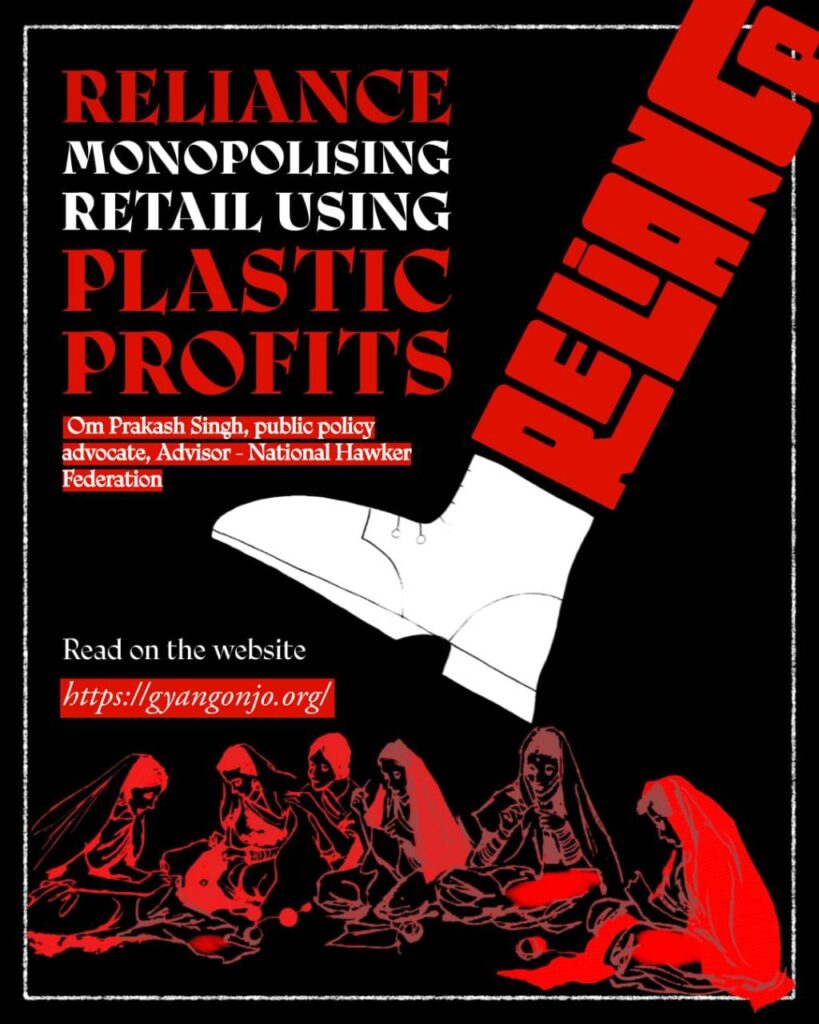
The biased and limiting nature of the ban also becomes clear when we understand that Reliance Industries has a monopoly on production of plastic in India. About 80% of single-use (or use and throw) plastic of India can be traced back to their Jamnagar petrochemical complex! So when street vendors purchase and use plastic, they are giving more business to their main competitor. Here is how this works. Reliance’s petrochemical and plastic empire is the main source of their profits. They use this profit to invest in other businesses like Retail and JioMart, where they use surplus cash from plastics business to offer deep discounts and steal customers from street vendors and small shopkeepers. The cycle is clear: plastic profits fuel retail monopolies, slowly pushing small vendors out of business — just as Jio once used cheap recharge rates to wipe out competition before raising prices later.
The story of plastics is not just about pollution; it is also about power, inequality, and survival. Street vendors, who contribute to the economy and keep our cities alive, are paying the highest price — with their health, livelihoods, and future.